
I Tried to Clone Jensen Huang's Little Yellow Duck — and Failed. But It Taught Me Everything About the Future of Embodied AI
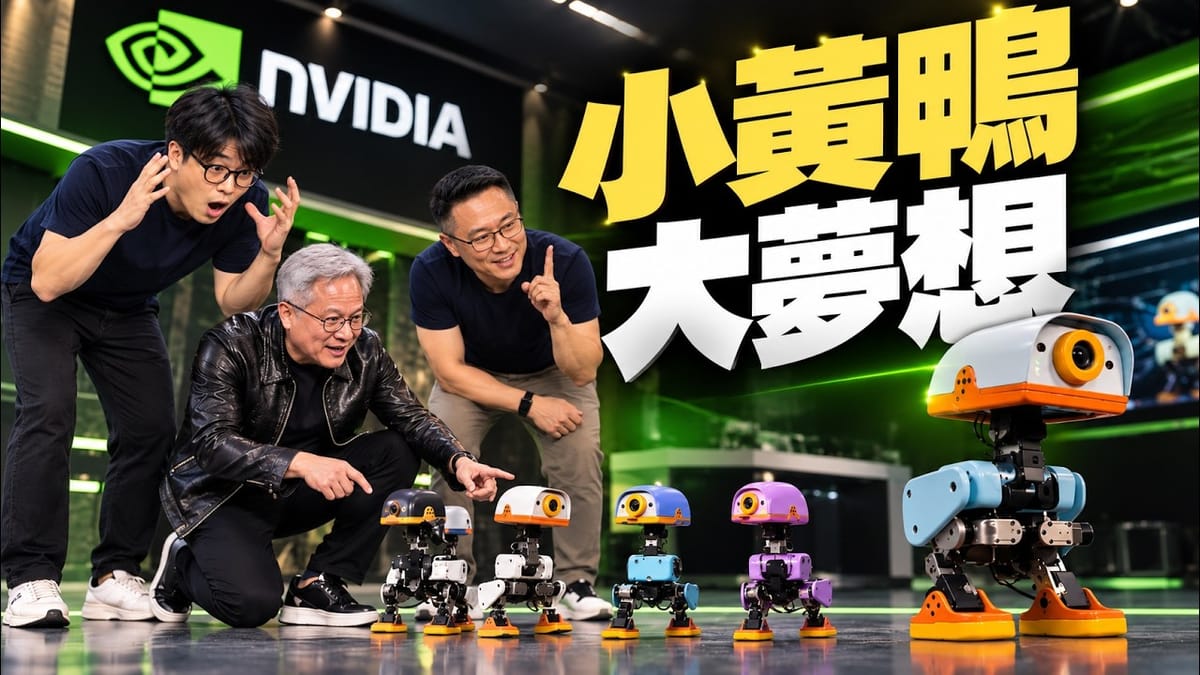
Last week at Nvidia's GTC in Berlin, Jensen Huang called a flock of little yellow ducks onto the stage. They waddled, did somersaults, and flopped over asleep on cue, and the whole room went "aww." But don't let this plastic duck — which doesn't even contain an Nvidia chip — fool you. You think Jensen is handing out Christmas presents to the world? Dead wrong. Inside this $399 duck is the most lethal long game Jensen has ever played to swallow the entire physical AI era. He isn't selling a toy. He's personally clamping a digital shackle on every future embodied-AI developer — one they'll never be able to shake off.
Even Huaqiangbei Can't Clone It
When I saw this duck was billed as "open source," my first reaction was exactly the same as every geek in China: isn't this just a kit? America open-sources it, China's Huaqiangbei copies the homework, and a $399 product becomes a 399 RMB build. Surely that's a matter of minutes, right?
Then I actually tried to build one, and reality slapped me hard across the face.
You think it's cheap? Just the 15 servo motors that keep the duck balanced, bought individually at retail, cost over $1,000 — more than 10,000 RMB. The actual cost of the loose parts grinds the $399 official price into the dirt.
And here's the weirder part: this duck doesn't contain a single expensive Nvidia GPU. The core controller parts are all made in China — it even runs on a few-dollar general-purpose board. Does that make any sense? When has Jensen ever done charity at a loss? Why would Jensen push a duck with none of his own chips inside and still be grinning ear to ear?
Ducklings Are Everywhere, but Jensen Owns the Farm
The answer is so simple it's suffocating: on-device chips don't matter. In Jensen's eyes, this duck never needed an Nvidia chip at all.
Think about it — how does a robot actually learn to walk? Can it just fall down tens of thousands of times like a toddler and figure it out on its own? Absolutely not. Can it plug into a GPT brain in the cloud? Don't make me laugh. Give it an LLM and it'll overthink for three seconds before every step, then freeze up at the first obstacle and smash itself to pieces.
Gait control for embodied AI has to go through brutally rigorous reinforcement learning. It needs to be pushed down, stood back up, and trial-and-errored hundreds of thousands of times in a simulated world before motor skills can be baked into the hardware.
And that's exactly where Jensen is most ruthless: you can grab a duckling anywhere in Huaqiangbei, but where are you going to teach it to walk? Only on Nvidia's digital-twin simulation platform.
And guess what? The motor dynamics models preloaded in Jensen's simulator are all Nvidia's proprietary libraries. Want to use a cheap domestic motor instead? Sorry — there's no digital model for it in the simulator, so you can't even run the first step of virtual training. If you want your duck to stand up, you have to buy Nvidia cards or rent Nvidia compute in the cloud.
$12.9 Billion? That's 22 Days of Jensen's Paycheck
Once you understand this duck, you instantly understand that wild acquisition that stunned the industry not long ago — dropping $12.9 billion to swallow the open-source community Hugging Face.
Most people's eyes bug out at the $12.9 billion figure. Remember, Hugging Face's revenue last year was only $150 million. At that price, the price-to-sales ratio is nearly 90x. Hugging Face would have to work 90 years without eating or sleeping just to buy itself back. Isn't that insane?
Insane? Who exactly is the one being clever here?
For an Nvidia empire with a market cap north of $5 trillion, $12.9 billion is one four-hundredth of its size. Do you know how long it takes Jensen to earn $12.9 billion? Just 22 days. That's right — 22 days of revenue, roughly 40 days of net profit. Jensen spent barely a month's "salary" to buy out, outright, the spiritual totem of tens of millions of active AI developers worldwide.
How brutal is this deal? Two points:
First, absolute defense. Microsoft had been circling. OpenAI had made contact. AMD even went asking about the price. If the world's largest open-source model hub fell into a rival's hands, a cornerstone of Nvidia's foundation would be chipped away. Jensen went all-in and smothered every potential threat in the cradle.
Second, he's choking off physical AI at the throat. Hugging Face's founder once publicly complained that the single biggest bottleneck was "not enough GPUs." Now Jensen is supplying the GPUs in abundance — and dumping all the duck training code on the platform. With one local card, or a few bucks for an hour or two of rented GPU time, you can train thousands of ducks at once. How did Jensen conquer the AI era with CUDA back in the day? By flooding universities with free GPUs and indoctrinating a whole generation of engineers from childhood. Today he's using the exact same playbook — welding the first milk that an entire generation of physical AI developers ever drinks directly onto Nvidia's mother ship.
Its Whole Selling Point Is That It's Useless — and That Uselessness Is the Killer Move
Plenty of self-styled industry experts are still sneering: "This duck can't go into a factory and tighten screws, it can't deliver takeout — apart from rolling around on a desk looking cute, what the hell is it good for?"
My god. The duck's greatest lethality is precisely that its whole selling point is being useless.
Go ahead, try sending a half-million-dollar humanoid robot into a factory. What does industrial manufacturing demand? 99.99% precision, assembly tolerances under 0.1mm, and a single second of line downtime costing millions. Every humanoid robot the big vendors have hyped to the heavens has, without exception, been beaten bloody by real industrial environments.
But does the little duck have to be accountable? Not at all! When it falls over, that's not a failure — it's a viral, adorable moment. When it mishears a command on stage, the audience assumes it's part of the sketch.
Back in the day, Jensen brought out a giant Disney robot that cost millions of dollars to develop — a luxury toy only giants could afford. Today he brings out a $399 duck. This isn't a downgrade. This is embodied AI's Raspberry Pi moment.
It demolishes the barrier to entry for physical AI. Even an ordinary programmer can have their own bipedal agent in a few hours. Raspberry Pi once set off a geek hardware-and-software frenzy; now Jensen has set that fire in the physical world. Who cares whether Jensen even remembers this duck a year from now? As long as millions of developers get lured into Nvidia's digital-twin ecosystem, Jensen's long game has already won.
A Creator God in the Virtual World, Harvesting in the Physical One
Once you see all this, you realize Jensen's ambition long ago outgrew being "the guy selling shovels."
In today's market, Google is selling TPUs externally, and every giant is building its own chips. Selling GPUs alone will eventually hit a ceiling. Jensen isn't content to be a hardware dealer. He wants to be the creator-god infrastructure of the physical AI era.
The sim-to-real gap really is absurdly wide. In the real world, motor heating and current jitter can tank development efficiency by a hundredfold or more. So what do you do? Jensen paints you a sunlit highway: since the real world is so hard to please, come build like crazy in my digital-twin world first.
Whether you're building a robot dog or a tiny biped, you have to keep dropping coins and respawning inside the physics engine Jensen built. The real physical world is endlessly varied — but inside Nvidia's virtual world, Jensen is the one and only creator god.
Look back at that moment at the Berlin keynote. Jensen sparred with the German Chancellor for over half an hour, practically slapping his thigh and shouting, "What are we even regulating for? Get building, brother!" That wasn't a conversation about tech. That was him showing his hand to the whole world. With a $399 piece of bait, Jensen has already fenced off the entire ground-floor entrance to physical AI as his own private garden.
After my failed clone got me brutally beaten down by reality, I looked at the half-finished toy on my desk — it can't even walk, it just quacks — and quietly opened the Hugging Face website. Fine. No more struggling. I'll just pay Jensen.
I'm in!
[Subscribe to the JustSayAI Daily Brief] 📮JustSayAI Daily Brief — subscriber-exclusive perks Two emails a day · one-tap audio brief! Now fully supported across email + IM + Skill endpoints