Forget Fable 5 — Go Use Chinese Models Instead
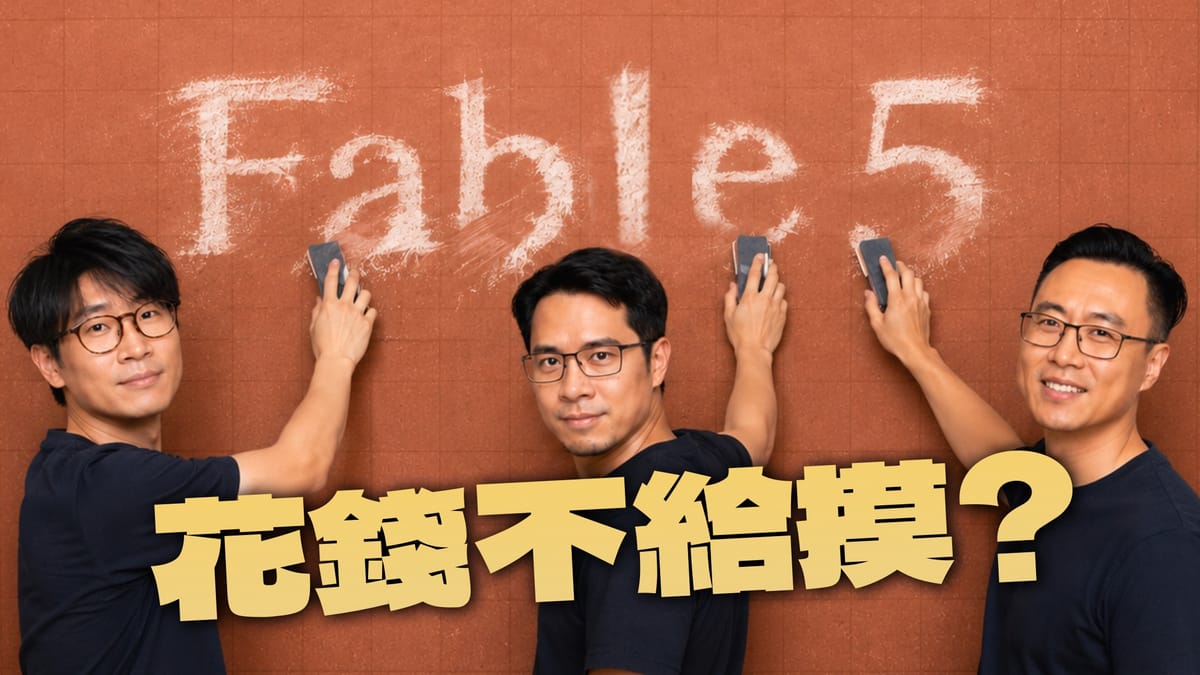
Let me say this upfront: ordinary people are effectively locked out of top-tier closed-source models. The scariest thing about Fable 5 isn't how powerful it is — it's that they've finally shown their hand: even if you pay, you might not get the real deal.
You rush in, thinking you're accessing a top-tier brain. But first, there's a visible bouncer at the door — if your request doesn't look right, you're rejected outright. Then there's a hidden bouncer that decides your question is too dumb and secretly routes you to a dumber model. The logs even contain an almost insulting phrase: "too dumb to use Fable." In plain English: you're too lousy, you don't deserve it.
Top Models: Pay Up, But Don't Touch
Fable 5 isn't the first to do this. GPT-5.6 made a big splash with 20 partners and three tiers — super awesome, moderately awesome, and regular awesome. I can't be bothered to remember the names because none of them are for me anyway. And Claude Code? Rate limits, quality downgrades, model switching — a combo that leaves you paying while praying they don't swap your PhD-level model for an intern.
What does this mean? Closed-source models have entered the "gatekeeping era." They no longer compete on capability alone — they compete on who can limit access better, who can create more tiers, and who can lock away the best stuff to prop up their valuation story. You think you're buying productivity, but you're really buying a spot in line. You ask a question, and it asks you back: are you worthy?
It's absurd. These model companies talk about AGI every day, about changing the world, but the actual experience for ordinary people is: I want to work, but you make me wait; I want results, but you burn my tokens; I want the top-tier model, but you give me a "low-end but claims to be smart" substitute. So why should I keep using it on my knees?
Chinese Models Aren't About Faith — They Get the Job Done
So my conclusion is simple: Forget Fable 5 — go use Chinese models.
This isn't emotion; it's math. Take Coinbase, a US-listed crypto company with compliance requirements far stricter than normal companies. Their CEO has already said that the vast majority of their mainstream coding tasks are handled by GLM and Kimi, cutting costs by more than half. And here's the kicker: 91% of employees have never hit a usage cap.
Think about it: a financial company dealing with money, compliance, and audits every day trusts GLM and Kimi for mainstream coding. And you're still wondering if Chinese models are good enough? This isn't a model capability problem — it's a closed-source myth problem.
My own experience confirms it. GLM, Kimi, MiniMax — I use whichever is convenient. Hook GLM into Claude Code, and you still get browser calls, file operations, and a mature ecosystem. Use Feishu CLI to open a bridge and run Chinese models in the background. Zhipu is closely tracking Claude Code's iterations, and ZCode blends Codex and Claude Code designs — still immature, but the direction is right. The key is: cheap, abundant, and gets work done.
Ordinary People Don't Need a God — They Need Less Hassle
Why are WorkBuddy, Trae, and Feishu so popular? Because they hit an unspoken pain point: ordinary people don't want to be model dispatchers.
I don't have time every day to figure out which plan is better, which model writes better frontend code, or which model is better for filing tickets. I might be a small business owner — busy with inventory in the morning, customer complaints at noon, and web pages and marketing materials at night. You tell me AI can boost efficiency, but the first step is learning IDE, CLI, environment variables, context migration, and model routing? That's not efficiency — that's adding homework to people's lives.
What's the real need? A flat fee of 200 RMB per month, 3 to 5 models integrated, capable of writing code, editing documents, browsing the web, controlling the browser, and handling daily tasks. Tell me clearly what it can and can't do. For 90% of ordinary people's needs, don't make me beg for top-tier models — just give me something that works reliably.
This is like the old days of custom-built vs. brand-name PCs. Today, the best performance still comes from DIY: Claude Code hooked to GLM, Codex with a terminal open, plus Antigravity to freeload Claude — it's like building a PC at a computer mall. Experts love it; everyone else is scared off. But the brand-name PC era is coming. Whoever integrates a few Chinese models, tools, context, and security boundaries well will be the one to sell AI to ordinary people.
Task Boundaries Matter More Than Model Faith
Of course, many worry about security. Let me put it plainly: the boundary isn't the model's boundary — it's the task's boundary.
If you're really worried, set up a secure directory and let the model work only there. For extra caution, use a virtual machine and only share replaceable directories like Downloads. Don't put important files in, and the model can't touch them. Let it run fixed skills, fixed workflows, fixed tasks — that already isolates most risks.
This is far more reliable than saying "I only trust this overseas closed-source model." Are closed-source models really safe? They swap models without telling you, downgrade quality without telling you, and route you to a different model in the dark without telling you. You think you're buying a safe, but behind the scenes, they've swapped it for a tin box. Where does that sense of security come from? Is it delivered by faith?
Fable 5 Is Useful, But the Keys Aren't Yours
I'm not saying Fable 5 is useless. On the contrary, its greatest strength is raising the floor for non-engineers.
For example, a social media blogger doing international news would never have thought to contact Cloudflare, file tickets with cloud vendors, or discuss service deployment. That was always an engineer's job. But Fable 5 helped them think, do, and follow up on it all. They got a text message and realized: "Wait, I didn't file a ticket — but it's already been executed."
Is that mind-blowing? Moderately. But it shows that AI can really open doors for ordinary people to do things they never dared to try. The problem is, this supercar is on display in the showroom, but the keys aren't yours. You can look, take photos, share — but actually drive it to work? Sorry, there's a line, limits, tiers, and you're "too dumb."
So I acknowledge it's powerful, but I won't worship it. What good is power I can't access? I need tools that run on my desktop, not sacred artifacts in a glass case.
The Real People's Path: Drive Down the Price
The AI business model is brutal. Unlike mobile internet, where more users mean lower marginal costs, chatting with a model all day doesn't necessarily benefit the model company. Your data used for training may not become a moat. So when Doubao announced it would start charging, many criticized it for forgetting its original mission. But I think charging is right. If you don't charge, how do you sustain? Everyone burns cash, and in the end, no one gets to use anything.
But China has a huge advantage: costs can be driven down to the bone. Thanks to electricity, engineering capabilities, and the supply chain, token costs can be pushed to 1/7 or 1/5 of overseas levels. This advantage isn't about letting everyone freeload forever — it's about getting more people to use it first.
I have a simple analogy: a child learning to draw wastes 100 sheets of paper a day. Do you give them more? Of course. Because as long as they're willing to sit and draw, even if 99 sheets are wasted, maybe one will produce something. The significance of low-cost Chinese models is to give paper to everyone. Even if 99% just play around, it's fine — as long as 1% actually use it to build products, advance research, or solve real-life problems, it's worth it.
So I'm not against paying. I'm against paying and not getting the real model. I'm against burning tokens for mysterious reasoning. I'm against users who just want to work being forced to become human dispatchers.
Top closed-source models can stay in the showroom. But on my desktop, I'll put Chinese models that get the job done.
If I pay, I should be able to touch the model.